
Partners
The institutions and instrument makers we work with on chitosan characterization and method development.

Measuring degree of deacetylation on a benchtop NMR.
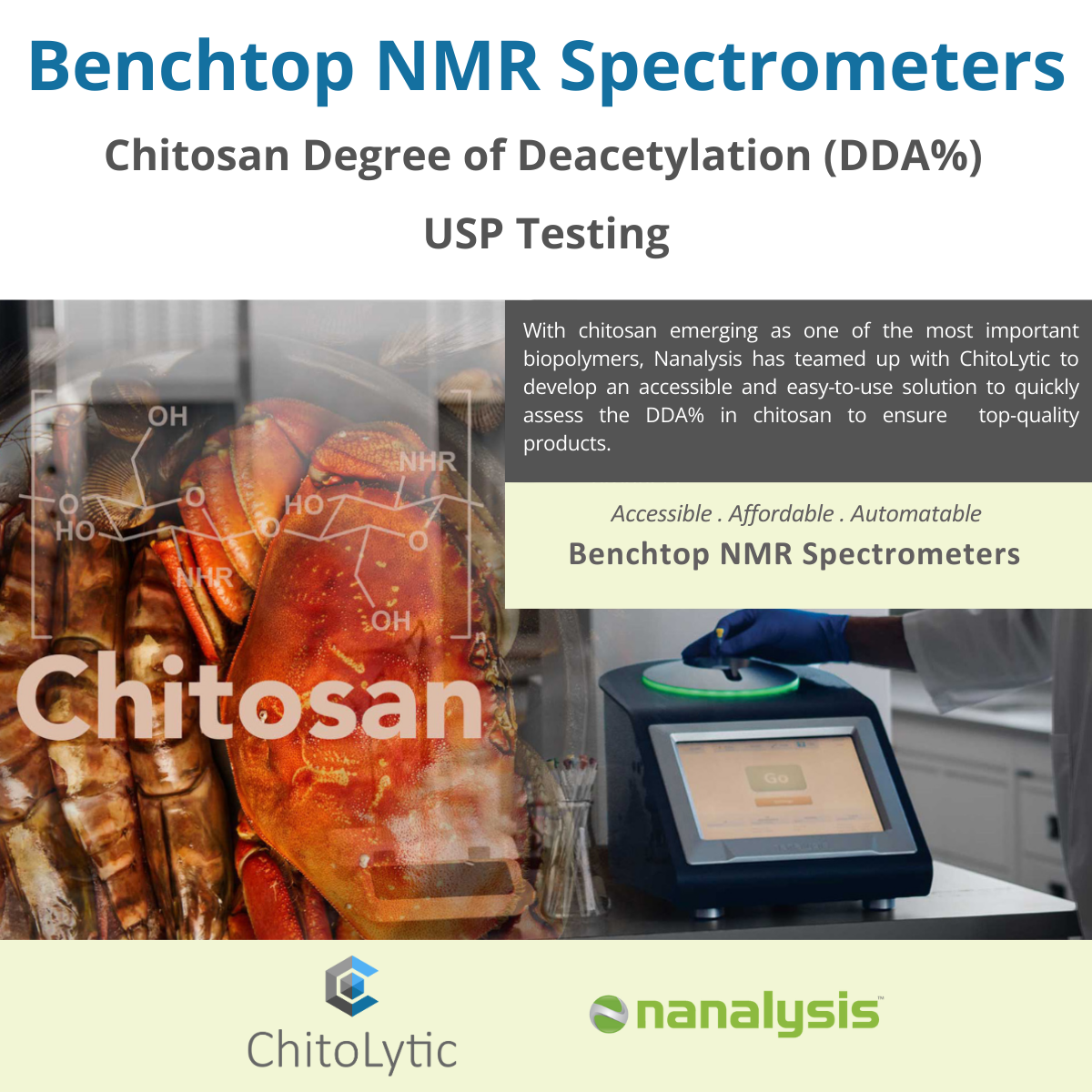
Chitosan is emerging as one of the most important biopolymers, and its degree of deacetylation drives most of what it does. Nanalysis teamed up with ChitoLytic to develop an accessible, easy-to-use way to assess DDA%, so quality can be verified rather than assumed.
The method follows the USP-NF monograph using 1H benchtop NMR, and was compared across seven chitosan samples. It is accurate, simple, rapid and cost-effective, and it runs on an instrument that sits on a bench rather than in a dedicated NMR facility.
Accessible. Affordable. Automatable.
- Follows the USP-NF monograph method
- Compared across seven chitosan samples
- Run on a benchtop instrument, no cryogens
The collaboration was announced in the Royal Society of Chemistry’s October issue, setting out why an accessible DDA% method matters as chitosan moves into regulated work.
- Published with the Royal Society of Chemistry
- Co-branded with Nanalysis

Measuring how chitosan gels behave, without touching them.
What makes chitosan useful is how adjustable it is, and that is also what makes it awkward to characterize. Molecular weight, degree of deacetylation and the crosslinking route all shift how a gel sets and how stiff it ends up, so gelation kinetics and mechanical behaviour have to be measured under conditions close to the intended use.
Rheolution’s ElastoSens™ Bio measures the viscoelastic properties of soft gels in real time, contactlessly and without destroying the sample. Their application scientists, Maya Salame and Dimitria Camasao, produced the two publications below in collaboration with ChitoLytic.
Between them they cover pH- and ion-induced gels, thermo-gelling formulations that turn from liquid to gel at 32–34 °C, and in-situ systems that have to end up as stiff as the tissue around them.
- How chitosan grades differ by molecular weight and degree of deacetylation
- The common routes to forming chitosan gels, and what each one changes
- Why soft hydrogels defeat conventional mechanical testers
- Worked examples in ophthalmic gels, nasal sprays and bone fillers
- Why microgels and beads are used in drug release, cell encapsulation and 3D bioprinting
- Shear storage modulus (G′) as the measure of gel stiffness
- Why soft, irregularly shaped gels are hard to characterize
- Comparing bead properties against their bulk counterparts