
Society For Biomaterials Forum Newsletter 4th Quarter 2020
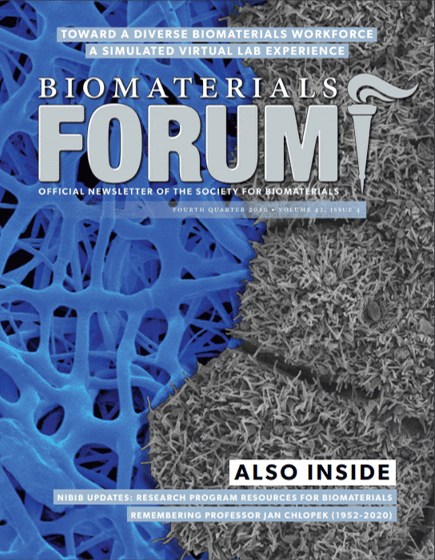
This issue of Biomaterials Forum highlights two important considerations related to how the Society uses funding to support biomaterials research.
In the first feature, Professor Daniel Herr and Dean Sherine Obare discuss the importance of using scientific funding to support women, Black, Hispanic and Latino people and differently-abled people, as well as others who have historically faced challenges in their pursuit of scientific careers. Recruitment and retention efforts to obtain individuals from diverse backgrounds must become a larger focus for decision-makers in academia and industry. Future issues of the Forum will highlight resources that the biomaterials community can use to connect with students and collaborators from diverse backgrounds.
The second feature highlights recent changes at the National Institute of Biomedical Imaging and Bioengineering that support biomaterials research. It is hoped that this article gives biomaterials scientists in academia and industry some insight into current funding trends. I plan to reach out to the Small Business Innovation Research program, as well as staff at other funding platforms, to provide their insight for upcoming issues of the Forum. It is hoped that this issue provides some ideas for the biomaterials community to consider and bring into a brighter, happier and more productive 2021.
Credits: All contents of this blog post, article, and attached Newsletter in whole and in its parts is solely and wholly the property of the Society of Biomaterials. Copyright © 2020 • ISSN 1527-6031 Society For Biomaterials All rights reserved. All of the contents within this blog post, article, and attached Newsletter are those of Society For Biomaterials. All representations do not and should not be implied any rights or ownership of Chitolytic, Inc.

Advanced Chitosan Bioactive Complex for Dental Regenerative Medicine
The Chitosan Complex (chitosan/ASAP and chitosan/ASAP/β-TCP) developed, tested, analyzed, and characterized provide valuable insights into the properties and potential applications in biomedical applications broadly and periodontal…
Read the article →
Tuning Chitosan Nanoparticles by Controlling Ionic Gelation
Ionic gelation is the preferred technique to produce chitosan nanoparticles. The properties of chitosan nanoparticles can be controlled by tuning the mixing technique of cross-linker and…
Read the article →
Chitosan Bioplastic Nurtures Plant Growth
%3Ciframe%20title%3D%22vimeo-player%22%20src%3D%22https%3A%2F%2Fplayer.vimeo.com%2Fvideo%2F87514098%22%20width%3D%22640%22%20height%3D%22360%22%20frameborder%3D%220%22%20allowfullscreen%3E%3C%2Fiframe%3E Researchers from Harvard University - Wyss Institute for Biologically-Inspired Engineering developed a fully degradable bioplastic by synthesizing chitosan with silk fibroin protein that mimics the…
Read the article →Working with chitosan in your research?
Tell us your target specification and application. We will recommend a grade and send a certificate of analysis.